How I think
Better questions lead to better organisations.
Thirty years have changed the question I ask.
Early in my career I thought my job was to find answers.
Now I believe my job is to ask better questions.
The first solution is rarely the right one.
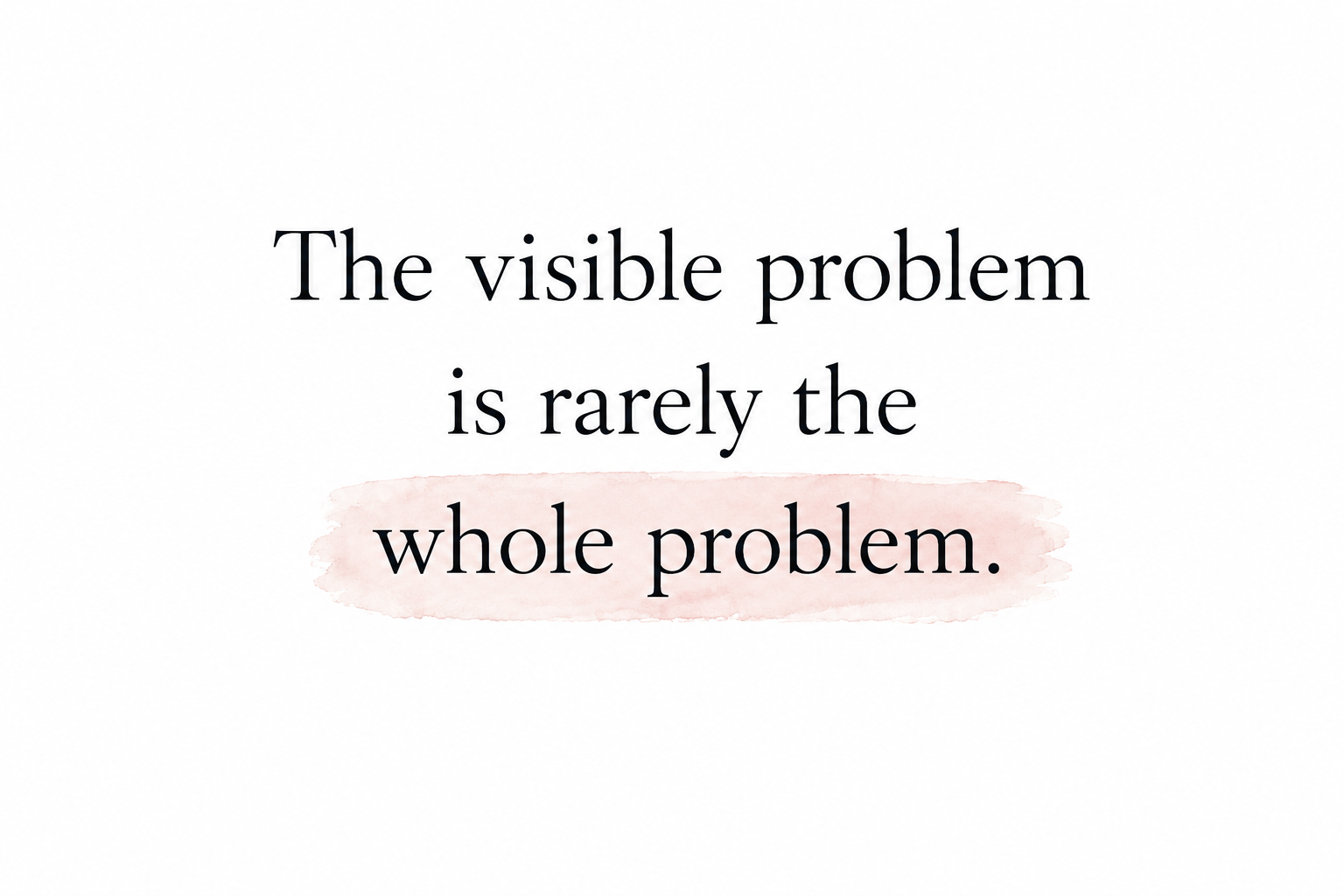
The visible problem is rarely the whole problem.
And the people closest to the work usually know far more than they realise.
My role is to create the conversations that uncover those insights.
Every organisation deserves its own answer.
I don't start with frameworks.
I start with curiosity.
I listen carefully, build hypotheses rather than conclusions, and look for what's missing as much as what's visible.
Capable people are often working incredibly hard to solve the wrong problem.
When priorities compete, governance becomes blurred or growth outpaces existing ways of working, small frustrations multiply into organisational drag.
Helping leadership teams untangle that complexity — and replace it with clarity — is work I've always enjoyed.
Change works best with people, not to them.
Progress comes through conversation, participation and practical action — not simply instruction.
What I've come to believe
Organisations are usually healthier than they think.
Most problems are more connected than they first appear.
Good decisions begin with shared understanding.
Clarity creates confidence.
Confidence creates momentum.
Sustainable change is built with people, never imposed on them.
The best leaders don't have all the answers.
They create the conditions for others to contribute them.
Where I think in public: Making Sense
A place where I work through the questions behind good work.
I write about leadership, organisational change, decision-making and the patterns that shape how work really gets done.
Often the starting point is something small; a conversation, a workshop, a piece of feedback, something I notice in everyday life, and the question it opens up.